Input and notation
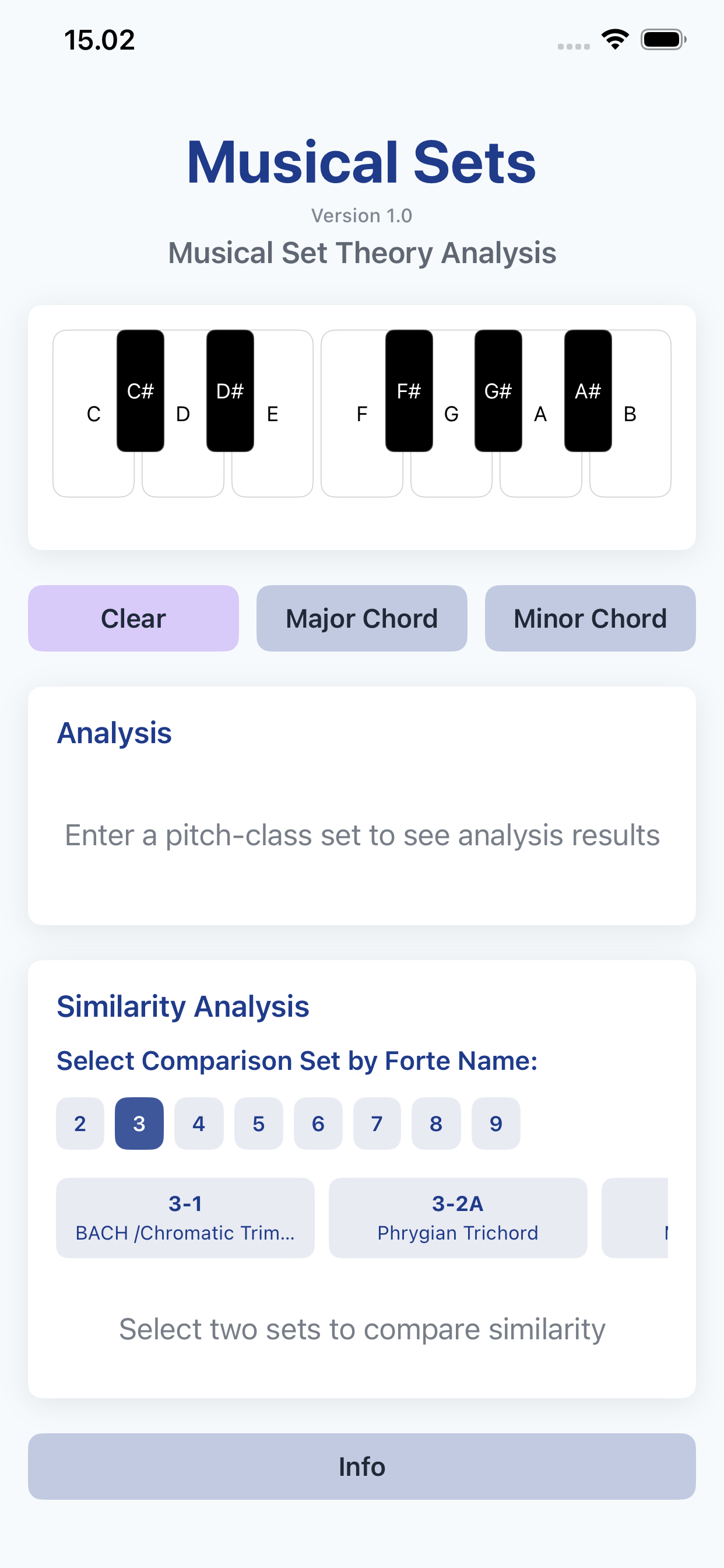
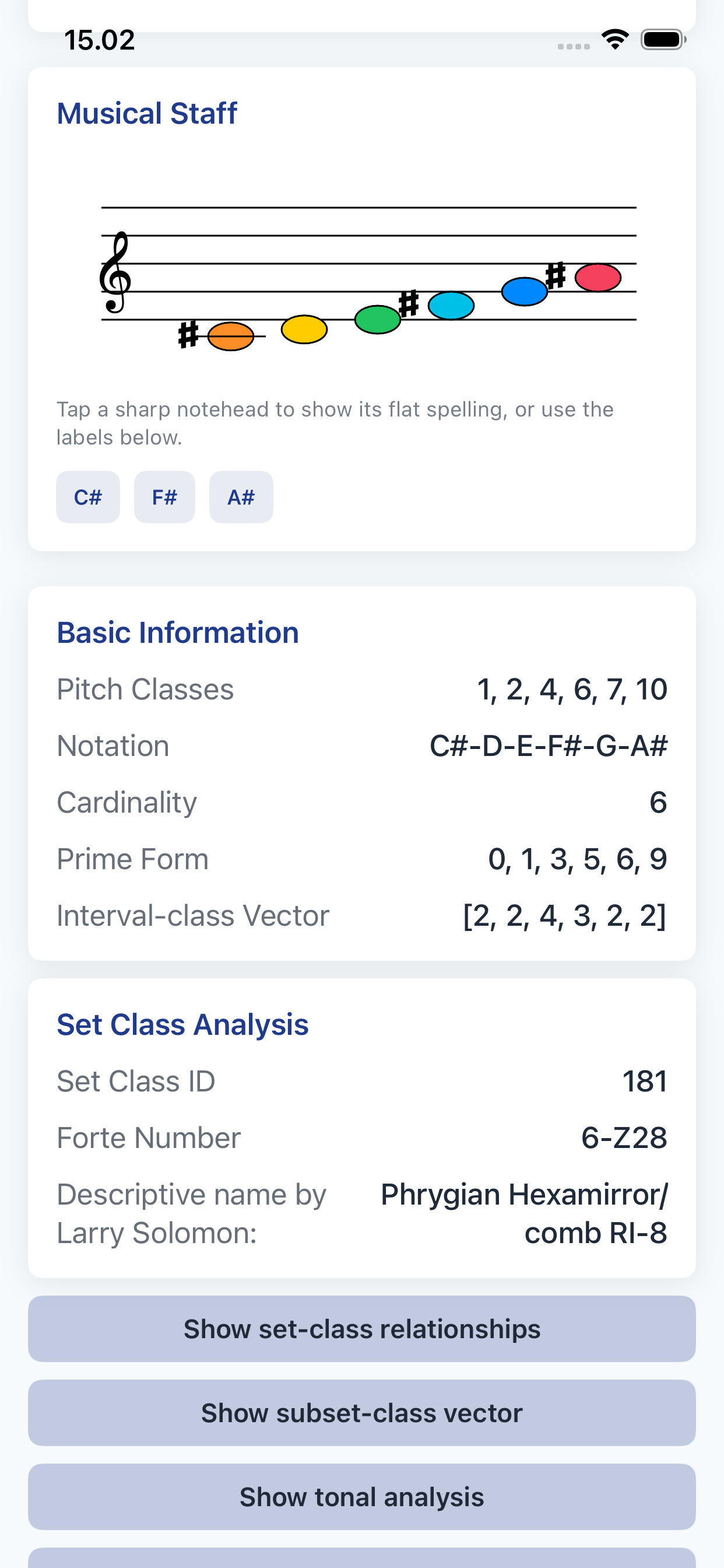
Select pitch classes from a compact keyboard. Staff notation supports enharmonic spelling, while contextual notation can show musically clearer spellings such as C-Eb-G for C minor.
iPhone app for musical set theory
A focused pitch-class set analysis tool for musicians, composers, theorists, and students.
Explore Forte classes, prime forms, complements, subsets, symmetries, tonal estimates, consonance, and set-class similarity from a clean mobile interface.
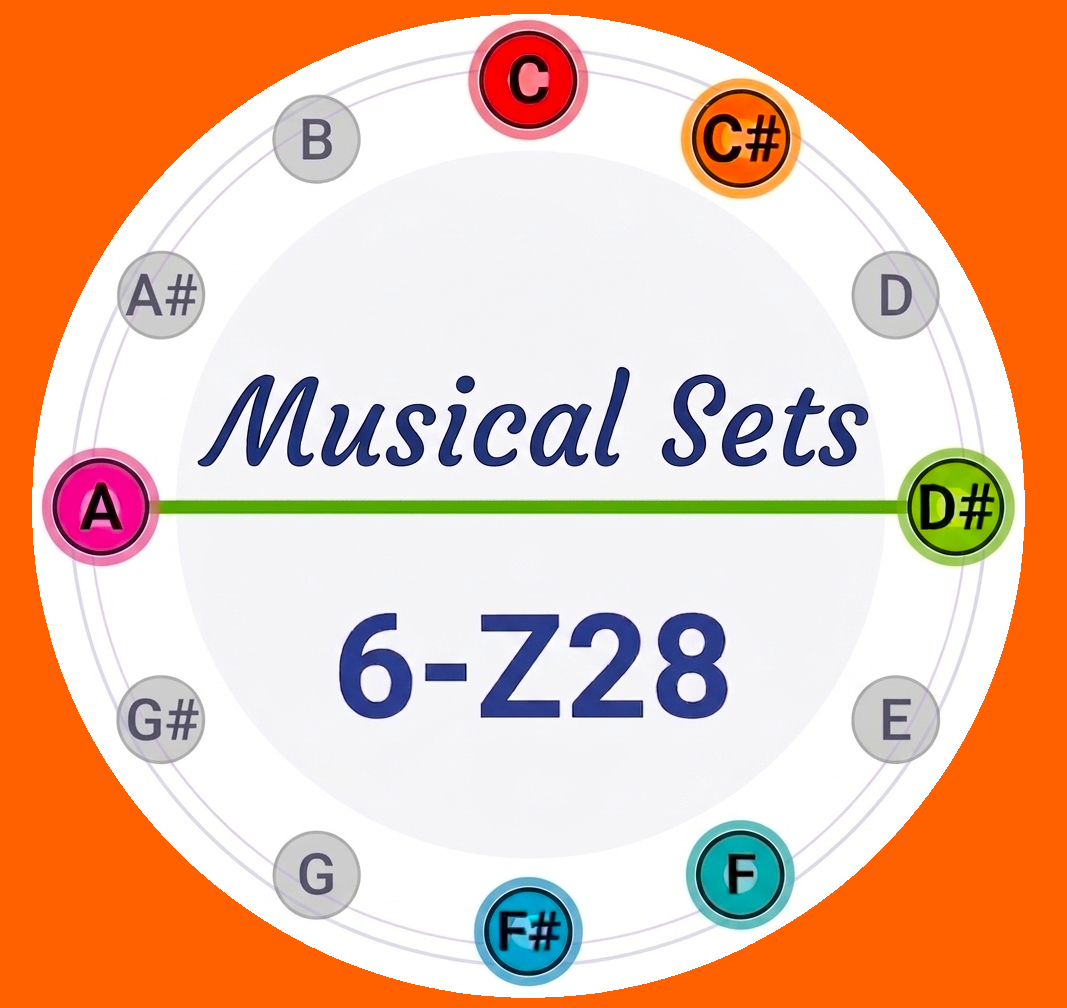
Analysis workflow
Musical Sets keeps the workflow direct: select pitch classes, inspect the resulting set, and compare it with other set classes.
Select pitch classes from a compact keyboard. Staff notation supports enharmonic spelling, while contextual notation can show musically clearer spellings such as C-Eb-G for C minor.
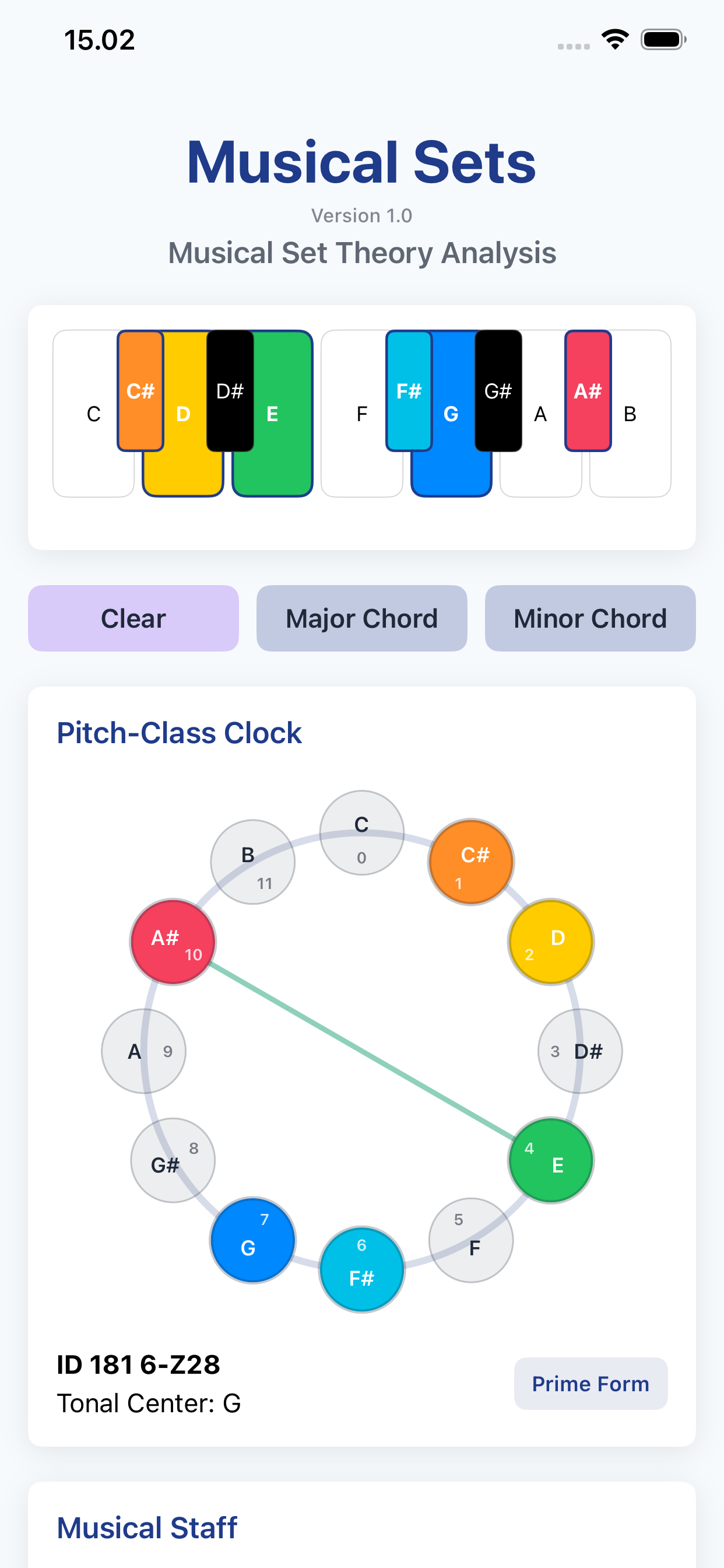
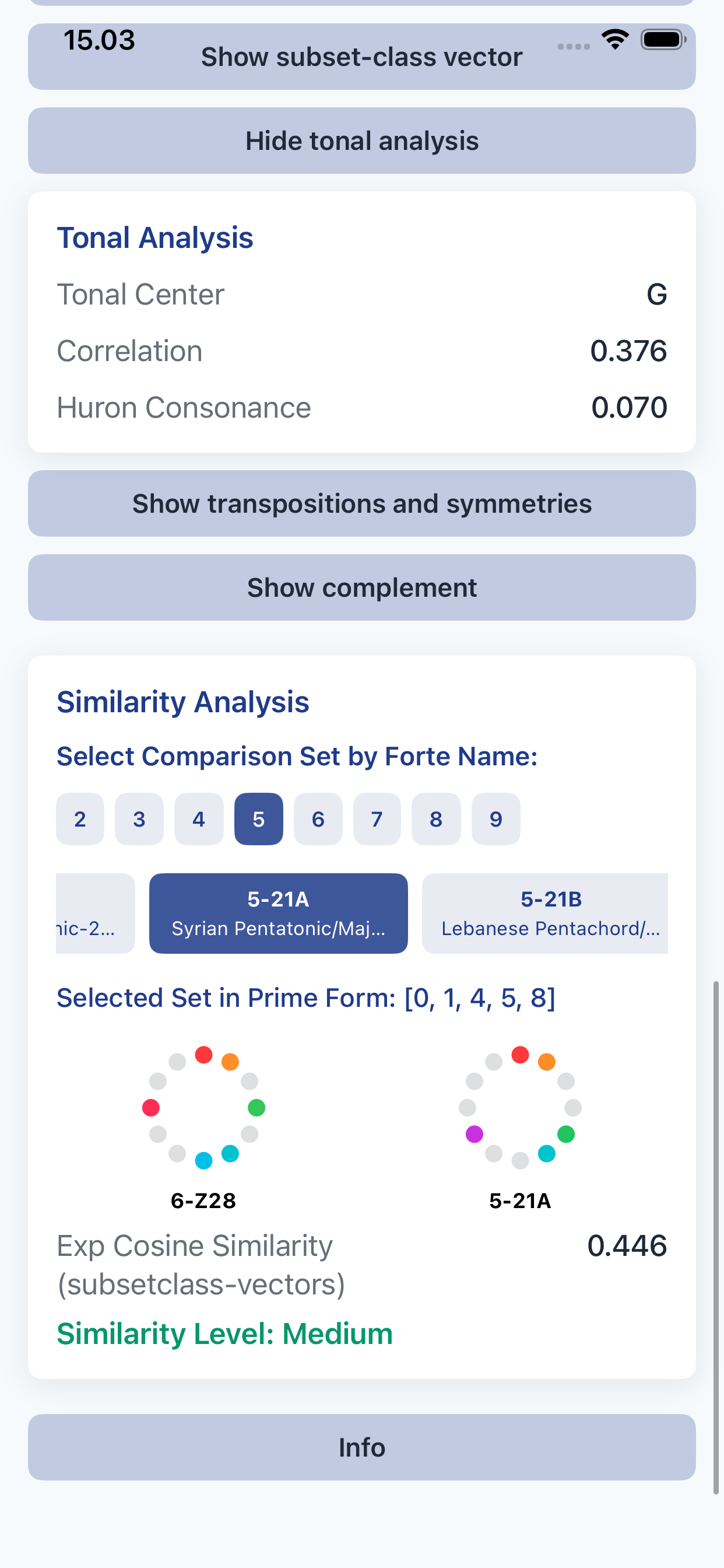
View cardinality, prime form, Forte number, Solomon descriptive names, interval-class vector, subset-class vector, complements, inversions, and Z-related observations.
Inspect pitch-class clock visualizations, tonal center estimates, Huron consonance values, transpositions, symmetries, generated collections, and similarity rankings.
Screenshots
Scope
Musical Sets analyzes abstract pitch-class content. It does not determine rhythm, register, voicing, instrumentation, tuning, style, or harmonic syntax. Results are intended to support listening, score study, composition, and theoretical comparison.
The app is especially useful for quick study of atonal and post-tonal materials, but it can also clarify familiar tonal collections through interval vectors, complements, subset relationships, and symmetry.